
di Ilaria Monti
– Italian version on page 2 –
Today, especially after our shared experience of lockdown, we can reflect on the many meanings the home has taken on over time and how its place in our collective imagination has changed. We might recall, for example, those advertising campaigns of the 1950s that portrayed women as the queens of household products. It was not uncommon to see advertisements featuring a subservient wife, or the latest product presented as easy enough for even a woman to use. In 2018, Lebanese visual artist Eli Rezkallah turned the sexist messages of these 1950s advertisements on their head in his photographic project In a Parallel Universe.

Those images of domestic (or domesticated?) women were challenged in the decades that followed, particularly in 1970s New York, one of the most vibrant centres of feminist thought. Here, American artist Laurie Simmons (born 1948) reconsiders the stereotypes women have had to contend with at home and in everyday life. A visual artist, photographer, and filmmaker active since the late 1970s, Simmons has explored domestic spaces from the outset of her career, influenced in part by her experience working for a company that made dolls and dollhouses. Her early works are photographs staged inside dollhouses, furnished to evoke the America of her childhood in the 1950s. Beneath this idealised, sometimes nostalgic vision of domestic interiors lies a feminist critique of the stereotypes that confined women at the time: the woman as doll is a lonely housewife who fills her days cleaning, preparing meals for her husband, or watching television on the sofa. Small scenes of ordinary life become dramatic and grotesque as they reveal how being a woman comes with an obligation to care for things. The woman, the quintessential homemaker and pillar of the household, becomes the very house she inhabits.

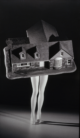
Beyond the dollhouse, the artist turns her attention to the consumer objects that fill our homes. The home becomes a small world of its own, where objects are alive and, like us, can talk and walk. Beginning in 1987, Simmons created Walking and Lying Objects, a series of photographs with echoes of Duchamp, depicting miniature objects fitted with women’s legs. The series, which she continued until 1991, has an atmosphere that is both playful and sensual: an hourglass, a pocket watch, a perfume bottle, a camera, a hot dog, pastries and cakes, a tomato, even a toilet and a gun—everyday objects caught mid-stride or striking a coy, distinctly feminine pose. Among the series’ most iconic photographs is Walking-House (1989), now in the photography collection of New York’s MoMA. In this work, Simmons places a miniature house atop a pair of women’s legs, but the framing removes any sense of its miniature scale, making the assemblage appear life-sized. The female body and the domestic space become one. A house with legs is a house that can escape, but a body inside a house is a body forced to stay. Together, house and legs suggest a home as destiny, or a home as prison: a fateful fusion in which the woman embodies the domestic hearth.
In 2005, Chanel commissioned Simmons to create Walking Chanel Purse, giving the French fashion house’s most classic bag a pair of legs of its own.
Especially now, as our everyday lives unfold within the walls of our homes, objects become the elements of a new domestic landscape. In Magnus Opus II (1991), Simmons stages a kind of procession featuring some of the objects we have already encountered: the toilet, the clock, the hourglass, the house, and others stand side by side, forming a small troupe out for a walk or sitting cross-legged on the ground. With their slender legs, Simmons’s Walking Objects resemble surreal cabaret dancers. They bring to mind the opening lines of a poem by Adam Zagajewski, collected in Dalla vita degli oggetti. Poesie 1983–2005 (Adelphi):
The smooth skin of objects is stretched taut
like a circus tent.


